
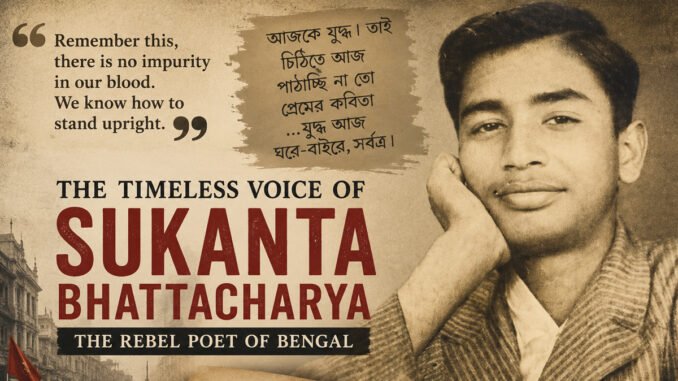
Arka Sana (Editor, The Bengal Express): “Remember this — there is no impurity in our blood. We know how to stand upright.”
Few poets in Bengali literature continue to pulse through generations with the same intensity as Sukanta Bhattacharya. Nearly eight decades after his death, his poems still sound less like literature and more like marching slogans carved out of hunger, rebellion, youth, and defiance. He lived for only 21 years, wrote seriously for barely six or seven, yet created a body of work powerful enough to immortalise him as the eternal poet of resistance, revolution, and restless youth.


There are poets who become literary icons. Then there are poets who become emotions. Sukanta belongs firmly to the latter.
His poetry was born out of famine, war, exploitation, political upheaval, and the burning impatience of a generation desperate to change the world. In poem after poem, Sukanta transformed ordinary Bengali words into weapons — sharp, fearless, uncompromising. Whether writing about hunger, labour, capitalism, fascism, or adolescence, he never romanticised suffering. He confronted it head-on.
Even today, when young readers encounter lines like “Eighteen knows no fear” or “In the kingdom of hunger, the world becomes prose”, they are not merely reading poetry; they are encountering a voice that still refuses to bow.


A Childhood Shaped by Loss and Literature
Sukanta Bhattacharya was born on August 15, 1926, in Kolkata’s Kalighat area, into a lower middle-class Bengali family. His father, Nibaran Bhattacharya, ran a small publishing and book-selling business, while his mother Suniti Devi nurtured the household through difficult financial circumstances.
Their ancestral home was in present-day Gopalganj district of Bangladesh.
The name “Sukanta” itself came from literature. It was chosen by his cousin Rani Bhattacharya after reading a story by writer Manindralal Basu. Rani played a profound role in Sukanta’s early life. She introduced him to stories, poetry, and literature at an age when most children are still learning alphabets.


Her sudden death deeply scarred the young Sukanta. Around the same period, he also lost his mother. Those twin tragedies brought an early loneliness into his life — a loneliness that later surfaced repeatedly in his writing.
Yet literature remained his refuge.
At just eight or nine years old, Sukanta published his first humorous short story in a school magazine. Soon after, his prose piece on Swami Vivekananda appeared in another literary publication. By the age of eleven, he had already written a musical play titled Rakhal Chele.
Even as a child, his creative instincts were impossible to ignore.
The Young Poet Who Chose Revolution
After completing primary education at Kamala Vidyamandir, Sukanta joined Beleghata High School. There he met poet Arunachal Basu, who would remain one of his closest lifelong friends.
Together they edited handwritten literary magazines like Saptamika and later Shatabdi. During these years, Sukanta’s poems began appearing regularly in newspapers and literary journals.
But literature was no longer his only obsession.
The political turbulence of the 1940s profoundly shaped him. The Second World War, the Bengal Famine of 1943, rising fascism, communal riots, colonial oppression — everything pushed him toward Marxist ideology and leftist politics.
While most teenagers worried about examinations and careers, Sukanta immersed himself in revolutionary literature, socialist theory, and political activism.
Formal education gradually became secondary.
In 1941, Sukanta joined the famous Galpo Dadu radio programme on Kolkata Radio, where he recited Rabindranath Tagore’s poetry. After Tagore’s death, Sukanta paid tribute by reading his own poems on air — a symbolic passing of poetic fire from one generation to another.
Music composer Pankaj Mullick even selected one of Sukanta’s songs for broadcast.
By 1944, Sukanta had formally joined the Communist Party of India. His involvement in political movements intensified dramatically. He became a full-time party worker, edited the “Kishore Sabha” section of the party newspaper Dainik Swadhinata, attended rallies, organised meetings, and travelled constantly.
Friends and colleagues later recalled that he seemed physically incapable of remaining silent in the face of injustice.
Poetry as Protest
Sukanta’s poetry was never detached from reality. It emerged directly from streets, hunger, labour, and conflict.
He wrote about broken staircases, famine-stricken faces, exploited workers, and rebellious youth with equal emotional force. Even ordinary household objects became political symbols in his hands.
Unlike many poets who viewed poetry as aesthetic beauty, Sukanta believed poetry must confront life.
That philosophy found unforgettable expression in one of his most famous lines:
“In the kingdom of hunger, the world becomes prose —
the full moon resembles burnt bread.”
Those words remain among the most devastating literary descriptions of poverty ever written in Bengali.
Sukanta did not write from intellectual distance. He wrote from lived experience. He knew deprivation intimately. His family struggled financially, and his political life exposed him directly to the harsh realities of Bengal’s working class.
His poetry therefore carried urgency rather than ornamentation.
“Eighteen Knows No Fear”
If one poem captures Sukanta’s eternal connection with youth, it is undoubtedly Atharo Bachhor Boyosh (“Eighteen Years of Age”).
Even today, the poem remains one of Bengali literature’s greatest celebrations of youthful rebellion.
“Eighteen knows no fear.
At eighteen, one dares to break stone barriers.”
These lines continue to resonate because Sukanta understood youth not as innocence, but as explosive moral courage.
For him, young people were not passive dreamers; they were agents of transformation.
That belief made him the definitive poet of political awakening for generations of Bengali readers.
Illness Could Break His Body, Not His Spirit
Years of relentless political work, poverty, and physical exhaustion eventually destroyed Sukanta’s health.
He first contracted malaria and later tuberculosis — the disease that would eventually kill him.
Yet even while bedridden, he continued writing.
One of the remarkable examples from this period was his poem Siri (“Staircase”), where he transformed the staircase inside his own home into a metaphor for class exploitation and inequality.
Even illness could not silence his political imagination.
Finally, on May 13, 1947, Sukanta Bhattacharya died at the age of just 21 at the Red Cure Home on Loudon Street in Kolkata.
India had not yet gained independence.
The revolution he dreamed of had not yet arrived.
But the poet had already become immortal.
A Legacy That Began After Death
Ironically, no major book by Sukanta was published during his lifetime.
His poems existed mainly in magazines, newspapers, and literary journals.
It was only after his death that collections like Chharpatra, Ghum Nei, and Mithe Kora were published and embraced by readers across Bengal.
Over time, Sukanta emerged not merely as a poet, but as a cultural force.
He wrote poems, essays, songs, stories, political commentary, and children’s literature with astonishing maturity for someone barely out of adolescence.
Many critics have compared him to English Romantic poet John Keats — another literary genius who died tragically young from tuberculosis. Yet Sukanta’s literary temperament remained uniquely his own: raw, political, impatient, revolutionary.
Poet Buddhadeb Basu once wrote that Sukanta looked like “a protest against convention itself.”
That may still be the most accurate description.
Why Sukanta Still Matters
In today’s world of cynicism and fatigue, Sukanta’s poetry continues to feel startlingly alive because it carries conviction.
He believed literature must stand beside ordinary people.
He believed hunger was political.
He believed youth could transform society.
And above all, he believed human dignity was non-negotiable.
That is why Sukanta survives beyond textbooks and literary anniversaries.
He survives in protest slogans.
He survives in student movements.
He survives whenever a young person refuses to lower their head before injustice.
His life was brief, but his voice remains thunderous.
Perhaps that is why, even today, Sukanta Bhattacharya does not feel like a poet from the past.
He still feels unfinished.

Leave a Reply