
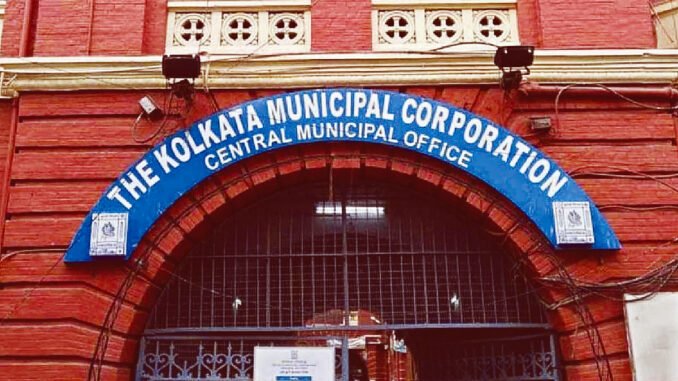
Even as the BJP celebrates a historic victory in West Bengal, a crucial political battle is now shifting to Kolkata, where the Trinamool Congress (TMC) still controls the civic body. With Assembly results indicating a sharp erosion of TMC’s urban support, the future of the Kolkata Municipal Corporation (KMC) has suddenly become uncertain, raising questions over whether the BJP’s momentum will extend into the state’s capital.
The BJP’s long-standing strategy to expand in eastern India appears to have paid off with its decisive win in the state Assembly elections. Now, the party is preparing to relocate the state secretariat from Nabanna to the historic Writers’ Building, symbolically reinforcing its administrative control. However, Kolkata—the political and economic heart of the state—remains under TMC’s grip, at least for now.


Municipal elections in Kolkata are due around December if conducted on schedule. But speculation is rife that polls could be advanced under the new regime. The numbers from the Assembly elections paint a challenging picture for the ruling TMC. Of the 16 Assembly segments that fall within the KMC area, the BJP has won 11. Ward-level trends are even more telling, with the BJP leading in over 100 of the 144 wards, while TMC trails significantly.
Within 72 hours of the election results, signs of unrest and internal dissent have surfaced within the TMC ranks. Several leaders, speaking privately, admit that retaining control of the Kolkata Municipal Corporation will be an uphill task. While the party has not made any public admission, there is a growing sense that a shift in power at the civic level may only be a matter of time.
The swearing-in ceremony of the new BJP government is scheduled at Brigade Parade Ground, but there has been no official announcement yet regarding the future of municipal bodies. Still, TMC leaders fear that elections across urban local bodies, including Kolkata, could be conducted earlier than expected.

Historically, Kolkata has been a stronghold of the TMC since 2011, with earlier victories in 2000 and 2010 during the Left Front era. However, critics have long alleged irregularities in municipal elections under TMC rule, claiming that polls were often delayed or tightly controlled. With the party now out of power at the state level, those advantages may no longer exist.
Some senior leaders within TMC acknowledge that public anger is not limited to the state leadership but extends to local representatives. Allegations of corruption, rapid accumulation of wealth, and the controversial “syndicate culture” have damaged the party’s credibility in urban areas. Unchecked real estate expansion, particularly in eastern Kolkata, has also drawn criticism over the years.
Ground-level reports suggest that TMC may still retain influence in minority-dominated pockets such as Kasba, Tiljala, Topsia, Khidirpur, Mominpur, Ballygunge, and Rajabazar. However, beyond these areas, the party’s organizational strength appears weakened.


Adding to the uncertainty, some TMC councillors have expressed concerns over safety and political pressure following the change in power. One councillor admitted that fear and intimidation have made it difficult even to step out or support party workers. “If we cannot stand by our workers now, will they stand by us during elections?” the councillor questioned.
The বিজেপি’s rise has also impacted other municipal corporations across the state. In Bidhannagar, TMC lost all Assembly segments under its jurisdiction. Similar trends are visible in Howrah, Chandannagar, Asansol, Durgapur, and Siliguri, where the BJP has made significant inroads.
As West Bengal undergoes a major political transformation, the focus is now shifting from the state Assembly to urban governance. Whether Kolkata remains TMC’s last bastion or becomes the BJP’s next conquest will likely be decided in the months ahead.

Leave a Reply