
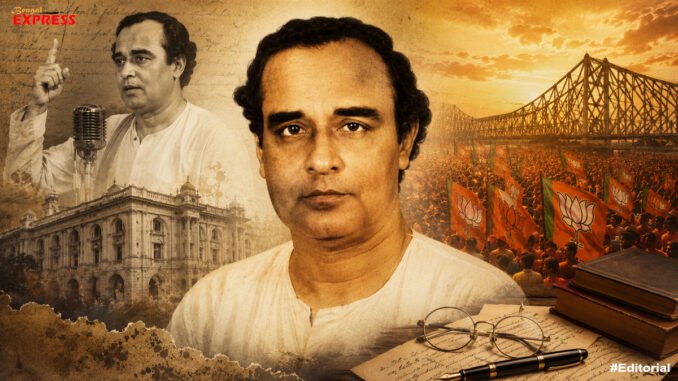
Arka Sana, Editor (The Bengal Express): As Bengal prepares to witness a historic political transition with the BJP set to form its first government in the state, the celebrations inside the saffron camp have reached an emotional crescendo. Suvendu Adhikari has been chosen as the BJP Legislature Party leader, and on Saturday, he is expected to take oath as the first BJP Chief Minister of West Bengal. Across party offices, RSS shakhas, and among thousands of BJP supporters, one name is echoing repeatedly — Dr. Shyama Prasad Mukherjee. But amid the celebration of a long-awaited dream, Bengal risks forgetting another towering figure without whom this moment would perhaps never have arrived: Haripada Bharati.
History is often cruel to those who build foundations. The architects of ideological movements are rarely remembered when victory finally arrives. Haripada Bharati belongs to that forgotten generation of Bengali political warriors who carried the flame of the Jana Sangh through decades of isolation, ridicule, and political irrelevance in Bengal.


Long before the BJP became an electoral force in the state, before rallies filled Brigade Parade Ground with saffron flags, before television studios debated “BJP vs TMC,” there was a soft-spoken philosophy professor who believed Bengal could one day embrace nationalist politics.
The Giant Behind Bengal’s Political Shift History Must Never Forget Haripada Bharati
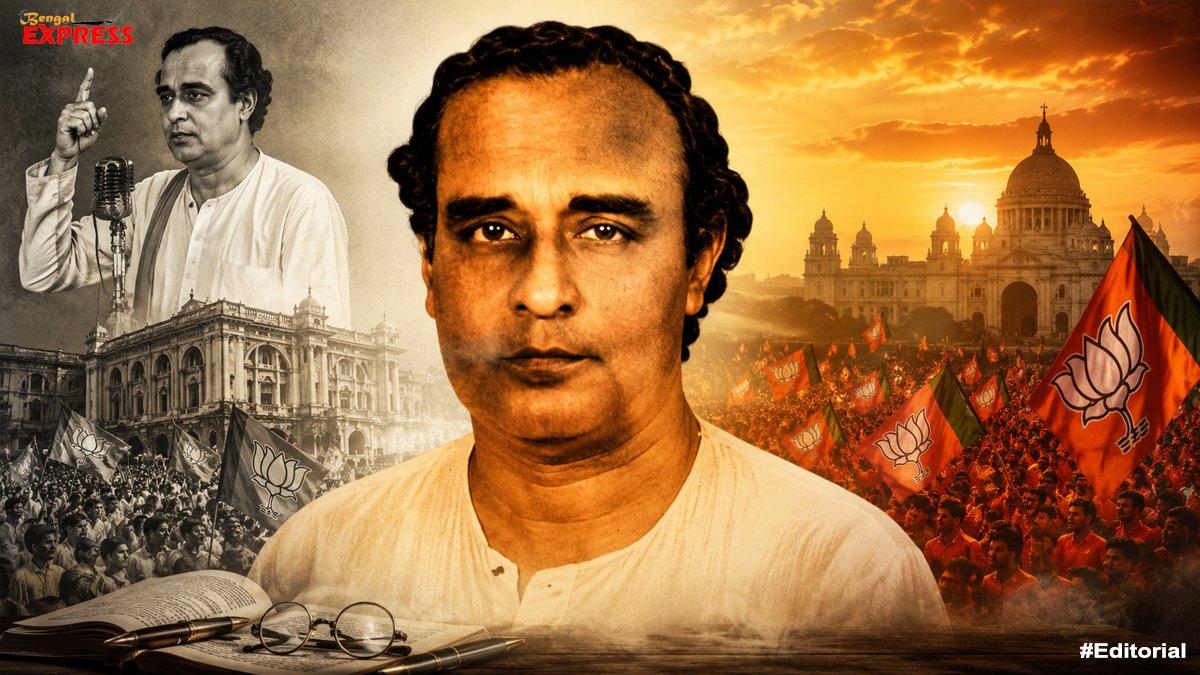
Haripada Bharati, affectionately known as “Mastermoshai,” was not merely the first state president of the BJP in West Bengal. He was one of the earliest Bengali intellectuals who dared to openly align himself with the ideology of Dr. Shyama Prasad Mukherjee at a time when doing so carried immense political cost.
Born in Jessore in undivided Bengal in 1920, Bharati’s life was deeply rooted in academia and public thought. A brilliant student of Scottish Church College, he stood first class first in Philosophy from Calcutta University in 1942. His journey as a professor began at Michael Madhusudan College in Jessore before he later joined Narasinha Dutta College in Howrah, eventually becoming vice-principal and principal.

But classrooms alone could not contain his convictions.
As a student, he was drawn toward the ideas of Shyama Prasad Mukherjee and joined the Hindu Mahasabha before later becoming part of the Bharatiya Jana Sangh. In Bengal’s deeply Left-dominated political landscape, Bharati became one of the few articulate nationalist voices capable of challenging the ideological monopoly of the communists.
What made Haripada Bharati extraordinary was not electoral success. It was moral credibility.


Even political rivals respected him. Inside the West Bengal Assembly, his speeches were heard in silence. Veteran legislators often recalled how even the CPI(M) benches refrained from interrupting him. There are stories — now almost legendary — that former Chief Minister Jyoti Basu himself occasionally allowed extra time for Bharati to speak, cutting down speaking time allotted to his own party members.
That respect was earned, not demanded.
During the Emergency, Haripada Bharati was imprisoned under MISA and lodged in Presidency Jail. From prison, he secretly wrote letters to his wife Pragati Bharati. Those letters later became the remarkable work “Jele MISA Baire MISA,” a deeply human account of imprisonment, resistance, and emotional endurance. Even inside prison walls, Bharati remained a thinker, describing the gardens and quiet beauty of Presidency Jail with philosophical tenderness.
He was not a politician driven by power. He was a politician driven by belief.
When he won from Jorabagan in 1977, it was more than a personal victory. It was proof that nationalist politics still had a pulse in Bengal. After the formation of the BJP, he naturally became the party’s first West Bengal president, carrying forward the ideological inheritance of Jana Sangh into a new political era.
Today, as Bengal stands on the verge of its first BJP-led government, Haripada Bharati’s absence feels profound.
The spotlight will rightly remain on Suvendu Adhikari, Amit Shah, Narendra Modi, and the new generation of BJP leaders. But before the oath-taking ceremony begins, before slogans shake Brigade Parade Ground, before victory speeches dominate headlines, Bengal’s BJP workers and supporters should pause for a moment and remember the man who walked this road when almost nobody else would.
Because history is not written only by those who finally win power.
Sometimes, history belongs more to those who carried the dream alone.
Haripada Bharati did not live to see this day. But perhaps, somewhere beyond the noise of politics, the old “Mastermoshai” finally knows that Bengal heard him after all.

Leave a Reply