
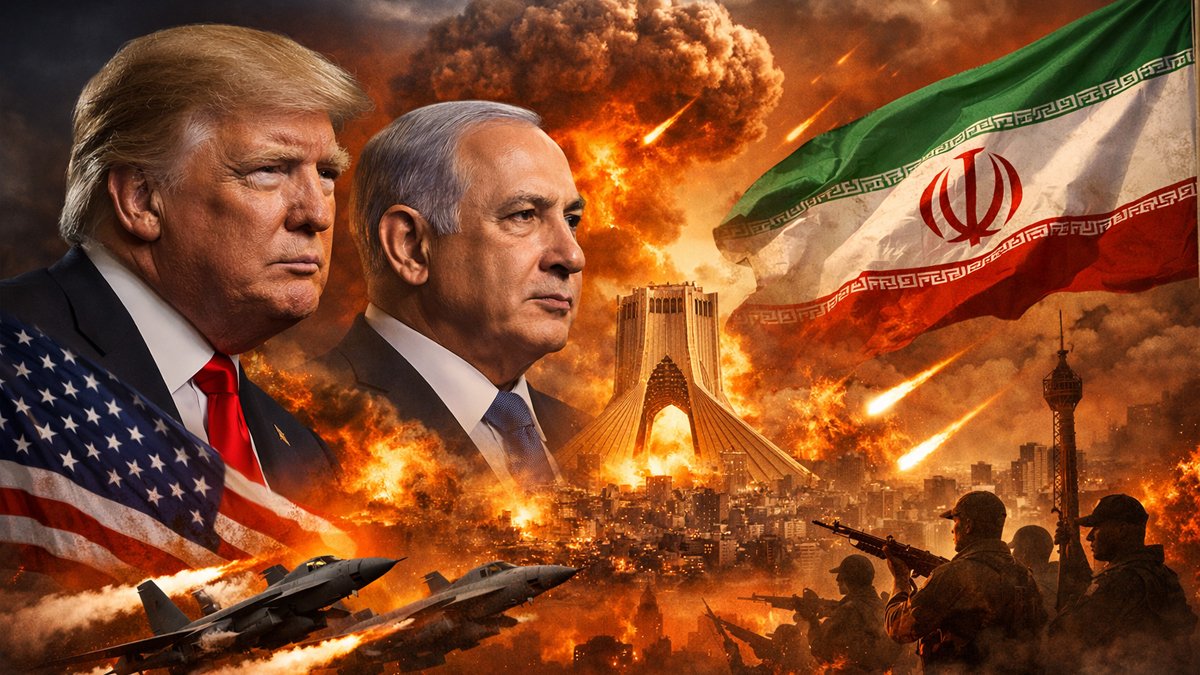
Loud explosions echoed across Tehran, Isfahan and Shiraz on Monday as the United States and Israel pressed forward with a sweeping military campaign against Iran — an operation President Donald Trump has warned could last “four weeks or more.” The offensive, dubbed “Epic Fury” by the Pentagon, has already reshaped the region’s political landscape, with Iran’s Supreme Leader Ayatollah Ali Khamenei reported killed in the first wave of strikes and hundreds feared dead nationwide.
What began as a series of coordinated air assaults has now evolved into a conflict with no clearly defined endpoint. While Trump has insisted the strikes were aimed at neutralizing a security threat rather than forcing regime change, questions remain about Washington’s long-term strategy — and how Tehran will respond.


Washington’s Objectives: Military, Not Political — Officially
Facing mounting criticism over the absence of a clear blueprint, the White House outlined four core objectives on Monday: dismantling Iran’s naval and military infrastructure, crippling its support for regional militant groups, and halting any potential nuclear weapons development. US Defense Secretary Pete Hegseth emphasized that this is “no democracy-building exercise,” distancing the current campaign from America’s protracted wars in Iraq and Afghanistan.
Secretary of State Marco Rubio struck a careful tone. While acknowledging that Washington would “love” to see Iranians topple their own government, he reiterated that regime change is not the formal goal.

Yet some analysts are skeptical.
Trita Parsi of the Quincy Institute described the strategy as less about replacing Iran’s leadership and more about triggering internal collapse. “It’s not regime change,” he argued, “it’s regime implosion — degrading the state’s capacities so deeply that it fractures from within.”
A Region on Edge


Explosions were reported in Isfahan and Shiraz even as at least 13 Iranian troops were said to have been killed in an airstrike on a southeastern air base, according to local media cited by the Associated Press.
Iranian officials have yet to outline a comprehensive counter-strategy, but observers believe Tehran may resist any swift ceasefire. Negar Mortazavi of the Center for International Policy noted that Iran is likely to seek a response forceful enough to deter future attacks. “The end goal,” she said, “is to ensure this hurts enough that the US, Israel and regional actors think twice next time.”
For Israeli Prime Minister Benjamin Netanyahu, weakening Iran’s military machinery is a longstanding priority. Israel has repeatedly targeted Iranian-linked assets in Syria and intensified operations in Gaza after the October 7, 2023 Hamas attack — a group widely believed to be backed by Tehran.
Americans Trapped in the Crossfire
As the war intensifies, US citizens in Israel are facing limited evacuation options. Ambassador Mike Huckabee warned that the US Embassy cannot currently assist directly in departures. Americans have been advised to travel overland to Egypt via Taba or attempt flights from Cairo, while routes through Jordan remain unreliable. Even when Tel Aviv’s main airport reopens, flights are expected to be severely restricted.
A broad swath of Middle Eastern airspace remains either closed or operating at minimal capacity, further complicating exits from the region.
Strategic Ambiguity — By Design?
Matthew Kroenig of the Atlantic Council suggested Trump may already view key objectives as achieved, particularly the elimination of a long-standing adversary in Tehran. “They could declare success almost at any time,” he said, implying the administration may be intentionally keeping its goals flexible.
Max Boot, a military historian at the Council on Foreign Relations, echoed that sentiment. Trump’s ambiguity, he argued, provides political cover regardless of the outcome. “Whatever happens,” Boot observed, “he will claim it was a huge victory.”
Meanwhile, Reza Pahlavi — son of Iran’s former Shah — has renewed calls for public uprising, signaling that opposition forces are closely watching developments.
How This Ends Remains Unclear
Despite confident rhetoric from Washington and Jerusalem, the war’s trajectory remains unpredictable. The administration appears eager to avoid another prolonged Middle Eastern quagmire. But Iran, a nation of nearly 90 million people with significant regional influence, may not yield quickly.
If the strategy is indeed about weakening Iran enough to prevent future threats without occupying territory or reshaping its political system, the coming weeks will test whether such a calibrated military campaign is even possible.
For now, the explosions continue — and so does the uncertainty.

Leave a Reply