
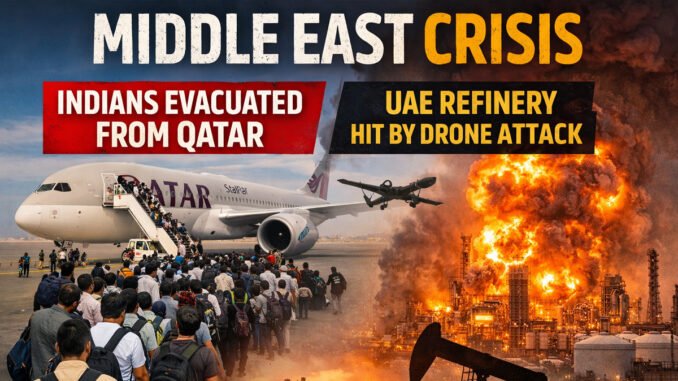
As tensions in the Middle East intensify, nearly 1,000 Indian nationals have been evacuated from Qatar while a major refinery in the United Arab Emirates suspended operations after a drone strike triggered a fire nearby. The developments come amid an escalating regional conflict involving Iran, the United States and Israel, raising fears of a wider disruption to global energy supplies and shipping routes.
According to the Indian Embassy in Qatar, around 1,000 Indian passengers departed on Qatar Airways flights to New Delhi, Mumbai and Kochi on March 10. The embassy said it worked closely with the airline to arrange travel for stranded Indian citizens and emergency cases as the security situation in the region deteriorated. Another Qatar Airways flight to New Delhi is scheduled to depart on March 11 as evacuation efforts continue.


The conflict has also begun affecting critical energy infrastructure in the Gulf. In the UAE, the massive Ruwais refinery — one of the largest in the world — halted operations on Tuesday as a precautionary measure after a fire broke out in a nearby industrial area following a drone attack. Authorities moved swiftly to contain the situation, but the incident has raised concerns about the vulnerability of key energy facilities during the ongoing conflict.
Meanwhile, Qatar confirmed it intercepted a missile attack targeting the country. Officials said Iran has intensified strikes against civilian infrastructure across the Gulf. Majed Al-Ansari, spokesperson for Qatar’s foreign ministry, warned that attacks on regional energy facilities could have severe global economic consequences.
“These attacks on energy infrastructure are a dangerous precedent,” Al-Ansari said, adding that disruptions in the Gulf’s energy network could ripple through the global economy.
The conflict has already started affecting oil production. Reports suggest the UAE has reduced its oil output by between 500,000 and 800,000 barrels per day. At the same time, Iran has vowed that no oil would leave the Gulf region while its war with the United States and Israel continues.
Despite the tensions, the UAE has insisted it does not want to be dragged deeper into the conflict. Jamal Al Musharakh, the UAE’s ambassador to the United Nations in Geneva, said the country was being targeted “in a very unwarranted manner” and stressed that Abu Dhabi has no intention of participating in attacks against Iran.
International responses are also beginning to emerge. Australia announced it would send a surveillance aircraft to the Middle East and supply advanced air-to-air missiles to help the UAE defend its airspace from Iranian strikes. Australian Prime Minister Anthony Albanese and Defence Minister Richard Marles said the UAE has already intercepted more than 1,500 rockets and drones since Iran began targeting Gulf states.


While security tensions rise, authorities in Dubai are trying to prevent panic among residents. Supermarkets across the city remain well stocked, with the food supply chain continuing to function despite disruptions in regional shipping. Officials say the country has enough food reserves to last several months and that price movements are being closely monitored.
However, the conflict has already disrupted shipping through the Strait of Hormuz — one of the world’s most critical trade routes. Cargo ships carrying commodities such as Indian rice, Australian meat and Indonesian coffee have faced delays as security risks increase in the region.
Iran has also targeted energy installations across the Gulf. In Bahrain, a petroleum complex at the Al Ma’ameer oil facility was struck, sparking a fire and causing significant damage. Bahrain’s state-owned energy company Bapco has declared force majeure, becoming the latest Gulf producer to suspend contractual obligations due to the crisis.
Meanwhile, political tensions between Washington and Tehran remain high. US President Donald Trump suggested the conflict might end soon but did not provide a clear timeline. “I think soon. Very soon,” Trump said while speaking to reporters in Florida.
Iran’s Revolutionary Guards responded sharply, stating that Tehran — not Washington — would determine when the war ends. The latest exchange underscores the uncertainty surrounding the duration of the conflict and the growing risks for the region’s energy infrastructure and global markets.

Leave a Reply