
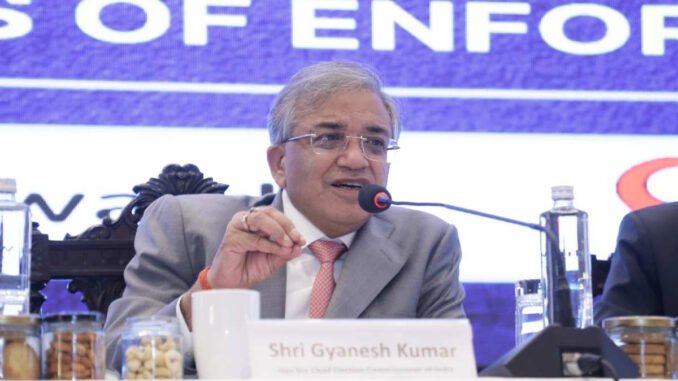
The Election Commission of India has indicated that West Bengal currently has a suitable environment for conducting Assembly elections, dismissing opposition claims that deteriorating law and order conditions make fair polling impossible. After a series of meetings with political parties and senior administrative officials in Kolkata on Monday, the Commission’s full bench said that while some localised issues exist, they are not serious enough to prevent the democratic process from taking place.
Chief Election Commissioner Gyanesh Kumar led the Commission’s delegation during the discussions. The full bench held separate meetings with representatives of eight recognised political parties and senior officials from the state administration and police, including district magistrates and superintendents of police from all 23 districts. Officials from 24 state and central agencies also participated in the deliberations.

According to Commission sources, the discussions were largely satisfactory. Opposition parties raised concerns about the law and order situation in the state and questioned whether the Commission could guarantee peaceful elections. However, the Commission maintained that the situation does not warrant postponing or questioning the conduct of polls.
A senior Commission official said that certain challenges do exist in West Bengal, but such issues are not uncommon during elections in several states. “There are some concerns in specific areas, but that does not mean the state lacks an environment suitable for elections,” the official said, adding that the Commission is satisfied with the administrative preparedness.
The Commission has already begun deploying central forces in the state even before the formal announcement of the election schedule. Explaining the move, the official clarified that early deployment is a standard practice used in several states to boost voter confidence and ensure security during the polling process.

However, the Commission also hinted at friction with the state government on certain directives. According to officials, some instructions issued by the Commission were not fully implemented by the state administration. They noted that once the Model Code of Conduct comes into force, the entire administrative machinery will come under the Commission’s supervision, ensuring neutrality in the electoral process.
Another major issue discussed during the meeting was the status of approximately 6.006 million voter records currently under verification. These entries in the draft voter list are being examined by authorities, raising questions about whether the process will be completed before the election schedule is announced.
The Commission indicated that there is still adequate time to resolve the matter. Officials said that nearly 100,000 cases are being processed every day, and eligible voters will continue to be added to the rolls until the last date for filing nominations. The issue is also under consideration by the Supreme Court, and the Commission declined to comment extensively on the ongoing legal proceedings.


During Monday’s meeting, the Commission also reportedly expressed dissatisfaction with some administrative lapses. State Director General (Law and Order) Vineet Goyal was questioned about the absence of a narcotics control advisory committee in the state. Officials from several agencies, including the Reserve Bank of India, airport authorities, excise officials and narcotics control units, were also warned about maintaining strict accountability.
Sources said the Commission emphasised that every official’s actions leave a “digital footprint” and that negligence would not be tolerated.
Despite occasional tensions during discussions with political leaders, Commission officials described the overall meeting with party representatives as constructive. Representatives from the Trinamool Congress, BJP, Left parties and Congress all raised their concerns, with most opposition parties urging the Commission to hold the election in one or two phases.
The Commission’s visit to West Bengal is part of its nationwide assessment ahead of Assembly elections in West Bengal, Assam, Kerala, Tamil Nadu and Puducherry. According to officials, Kerala currently appears to be administratively the most prepared, while some challenges exist in West Bengal and Tamil Nadu.
The Commission is scheduled to hold another meeting with Chief Secretary Nandini Chakraborty and senior state officials on Tuesday before addressing the media and returning to Delhi later in the day. The election schedule is expected to be announced in mid-February.

Leave a Reply