
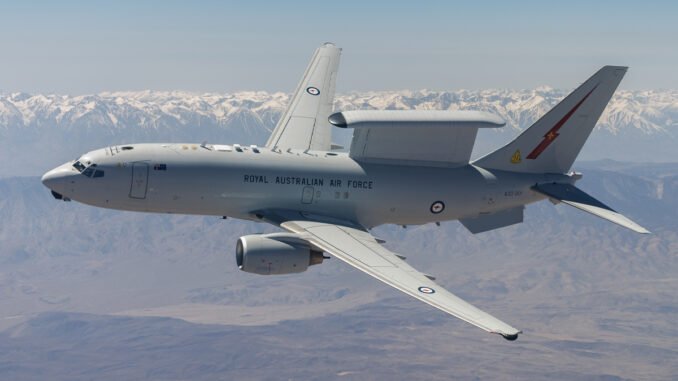
Australia has announced the deployment of its advanced E-7 Wedgetail surveillance aircraft to the Gulf region, stepping up aerial monitoring amid rising tensions and repeated drone and missile threats in West Asia. Prime Minister Anthony Albanese confirmed the move on Tuesday, saying the aircraft will act as a “flying guardian” to help protect the airspace of Gulf nations and respond swiftly to any hostile aerial activity.
The powerful airborne early warning and control aircraft will conduct surveillance operations across the Gulf’s airspace, detecting potential threats such as missiles or drones long before they reach their targets. According to the Australian government, the deployment is initially planned for four weeks and aims to strengthen regional security coordination with Gulf allies.


The decision follows recent discussions between Albanese and United Arab Emirates President Sheikh Mohamed bin Zayed Al Nahyan, particularly after a series of alleged attacks targeting Gulf states. Countries such as the UAE, Qatar, Kuwait and Bahrain have reported repeated drone and rocket threats in recent months, with Iran frequently accused by regional governments of being behind the assaults.
Australia’s prime minister said the deployment is also linked to the safety of Australian nationals living in the region. Around 24,000 Australians currently reside in the UAE alone, making their protection a priority for Canberra.
Albanese noted that the UAE has already intercepted nearly 1,500 rockets and drones in recent attacks. In addition to the surveillance mission, Australia plans to strengthen defence cooperation with the Gulf state by supplying military equipment, including medium-range air-to-air missiles.


“Our government’s foremost responsibility is to ensure the safety of Australians in West Asia,” Albanese said, adding that protecting Australian citizens is closely tied to maintaining stability and security across the Gulf region.
The aircraft being deployed, the E-7 Wedgetail, is one of Australia’s most advanced military surveillance platforms. Built on the Boeing 737-700 airframe, the aircraft has been heavily modified for combat support and battlefield monitoring.
The Wedgetail is equipped with Northrop Grumman’s Multi-role Electronically Scanned Array (MESA) radar, which allows it to track multiple airborne targets across vast distances. The system can collect intelligence from multiple sources and provide real-time battlefield information to allied forces, enabling rapid responses to emerging threats.


Australia currently operates a fleet of six E-7 Wedgetail aircraft, which are considered among the most capable airborne early warning systems in the world.

Leave a Reply