
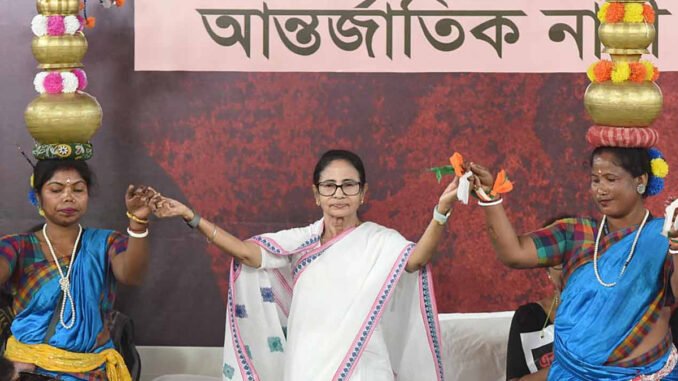
West Bengal Chief Minister Mamata Banerjee on Friday announced the formation of five separate cultural and development boards for specific communities in the state, a move that comes months before the Assembly elections and amid rising political tensions over the recent controversy involving President Droupadi Murmu. The decision, observers say, could carry both social and electoral significance, particularly in regions where political competition between the Trinamool Congress and the BJP remains intense.
In a social media post, Banerjee said her government plans to set up dedicated boards for the Munda, Kora, Dom, Kumbhakar, and Sadgop communities. According to the Chief Minister, these boards will focus on preserving the communities’ cultural identity and languages while also working to improve access to education, healthcare, and employment opportunities.


Banerjee highlighted that the Trinamool Congress government has been creating similar boards since 2013 to support economically and socially disadvantaged groups across the state. The initiative, she said, aims to ensure inclusive development and targeted welfare programmes for communities that require special attention.
Among the five communities named, Munda and Kora belong to the Scheduled Tribe (ST) category, while Dom is classified as a Scheduled Caste (SC) community. The Kumbhakar and Sadgop communities fall under the Other Backward Classes (OBC) category.
Demographically, many members of the Munda, Kora, and Dom communities live in the western districts of West Bengal, including Bankura, Purulia, Jhargram, and parts of West Midnapore. The Sadgop and Kumbhakar communities, however, are spread across multiple districts throughout the state.
Political observers believe the timing of the announcement is significant. The western districts of Bengal have traditionally been politically sensitive areas where the Bharatiya Janata Party (BJP) has built considerable influence over the past decade.
In the 2019 Lok Sabha elections, the BJP dominated much of this region. The Trinamool Congress regained some ground during the 2021 Assembly elections, winning all four seats in Jhargram district. Later, in the 2024 Lok Sabha elections, the ruling party managed to wrest control of Bankura, Jhargram, and Medinipur parliamentary constituencies from the BJP, although the BJP retained Purulia.
Despite the improved performance, analysts say the Trinamool Congress remains keen to consolidate its support base in western Bengal ahead of the next Assembly elections.


The recent controversy surrounding President Droupadi Murmu has further complicated the political landscape. The BJP has accused the state government of disrespecting the President during her recent visit to West Bengal, a charge the ruling party has denied.
Murmu had visited the state last week to attend the International Indigenous Conference in north Bengal. Her scheduled programme in Bidhannagar, Siliguri, was shifted to Gossainpur near Bagdogra citing security concerns, a decision that reportedly displeased the President.
Murmu later travelled to Bidhannagar and publicly questioned why neither the Chief Minister nor any senior minister had been present at the airport to receive her. The remarks triggered a sharp political exchange between the BJP and the Trinamool Congress.
Prime Minister Narendra Modi, several Union ministers, and BJP leaders — including Uttar Pradesh Chief Minister Yogi Adityanath — criticised the state government over the issue.
Trinamool leaders, including Mamata Banerjee, rejected the allegations and defended the state administration’s actions.
In the aftermath of the controversy, Trinamool MPs sought an appointment with President Murmu to present a report outlining the West Bengal government’s welfare initiatives for tribal communities. However, Rashtrapati Bhavan declined the request on Thursday, citing scheduling constraints.
According to reports from news agency PTI, the party plans to seek another appointment with the President next week.
For now, while the state government frames the newly announced development boards as part of its long-standing welfare policy, the political context surrounding the move suggests that the decision may also carry significant electoral implications ahead of the next Bengal Assembly polls.

Leave a Reply