
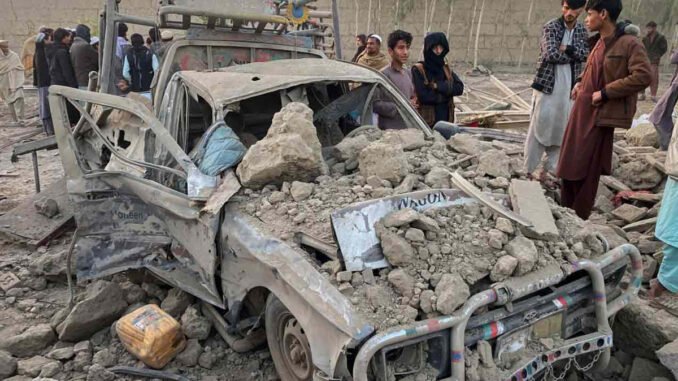
Tensions between Afghanistan and Pakistan have escalated sharply after the Pakistani Air Force allegedly carried out multiple airstrikes across Afghan territory early Friday, including in the capital Kabul. Afghan officials claim several cities were bombed in the early hours, leaving civilians dead and injured. The Taliban administration has issued a stern warning, saying that if the attacks continue, Pakistan’s major cities such as Islamabad and Karachi could become targets of retaliation.
Kabul police spokesperson Khalid Zadran confirmed that explosions were reported in several areas, including Kabul, Kandahar, Paktia and Paktika provinces. According to local authorities, the strikes began before dawn and continued for hours, sending residents scrambling for safety.

One of the reported targets was an oil depot located near Kandahar Airport, which was hit during the bombardment. Afghan officials say the attacks struck areas close to civilian settlements, causing panic among residents. Initial reports indicate that at least five people, including women and children, were killed, while several others sustained injuries.
Taliban sources have accused Pakistan of deliberately targeting populated areas. However, at the time of publication, Pakistan’s military had not issued an official statement regarding the latest strikes.
The Taliban administration reacted sharply, condemning the operation and warning Islamabad against further military action. Haji Zahid, spokesperson for the Taliban governor of Balkh province, said Pakistan would face serious consequences if the attacks continued. He claimed that major Pakistani cities could be targeted in retaliation if the bombing does not stop.

The latest escalation comes amid already strained relations between the two neighbours. Even before the wider geopolitical tensions in West Asia intensified, border clashes between Afghanistan and Pakistan had become increasingly frequent.
Both countries have repeatedly accused each other of violating airspace and carrying out cross-border attacks. The situation deteriorated further toward the end of February when Pakistan allegedly conducted airstrikes in Afghanistan’s Paktika province.
Afghan authorities claimed that Pakistani JF-17 fighter jets were used in that operation and alleged that several civilians were killed in the bombing. The Taliban leadership vowed at the time that the attack would not go unanswered.


Following those threats, Taliban fighters reportedly launched a series of retaliatory strikes against Pakistani military posts along the border, claiming to have destroyed multiple checkpoints.
Pakistan, however, has consistently denied targeting civilian areas. The Pakistani military has argued that its operations are aimed at militant hideouts inside Afghanistan, accusing insurgent groups operating from Afghan territory of carrying out attacks across Pakistan.
Islamabad maintains that its military actions are necessary to safeguard national security and prevent cross-border militant activity that has destabilised parts of the country.
With both sides trading accusations and warnings of retaliation, analysts fear that the situation along the Afghanistan-Pakistan frontier could spiral into a broader confrontation if diplomatic channels fail to ease tensions.

Leave a Reply